Gooseneck Kettle Pour Over UK 2026: Temperature and Flow Control
A 2026 guide to gooseneck kettles in the UK, covering pour control, variable temperature, PID accuracy and five picks for pour over coffee.
Gooseneck Kettle Pour Over UK 2026: Temperature and Flow Control
If you brew filter coffee by hand, the kettle is not a peripheral — it is the tool you use to control the brew. A standard kitchen kettle dumps water in an uncontrollable gush that channels straight through the coffee bed; a gooseneck lets you place a thin, steady stream exactly where you want it. This guide is based on desk research: manufacturer specifications, retailer listings, and owner reviews on Amazon UK and specialist roasters rather than first-hand testing. Below you will find a shortlist, a comparison table, notes on five kettles, and an explanation of why water temperature matters as much as the spout.
Quick Picks
| Best for | Model | Why we picked it |
|---|---|---|
| Best overall | Fellow Stagg EKG | Precise variable temperature control, excellent pour, and a hold function. |
| Best value electric | Cosori Variable Temperature Gooseneck | Variable temperature and good pour control at well under premium prices. |
| Best stovetop | Hario Buono V60 | A simple, well-balanced pouring kettle for anyone who already has a thermometer. |
Comparison Table
| Model | Type | Variable temperature | Hold function | Approx price |
|---|---|---|---|---|
| Fellow Stagg EKG | Electric | Yes, 1°C increments | Yes, 60 minutes | around £160–£200 |
| Cosori Variable Temp Gooseneck | Electric | Yes, 5 presets | Yes | around £60–£90 |
| Brewista Artisan | Electric | Yes, 1°C increments | Yes | around £110–£150 |
| Hario Buono V60 | Stovetop | No | No | around £35–£55 |
| Timemore Fish Smart | Electric | Yes, 1°C increments | Yes | around £90–£130 |
Prices are indicative and were correct at the time of writing. Kettles are discounted regularly, so always check the current price before you buy.
Why the Spout Shape Matters
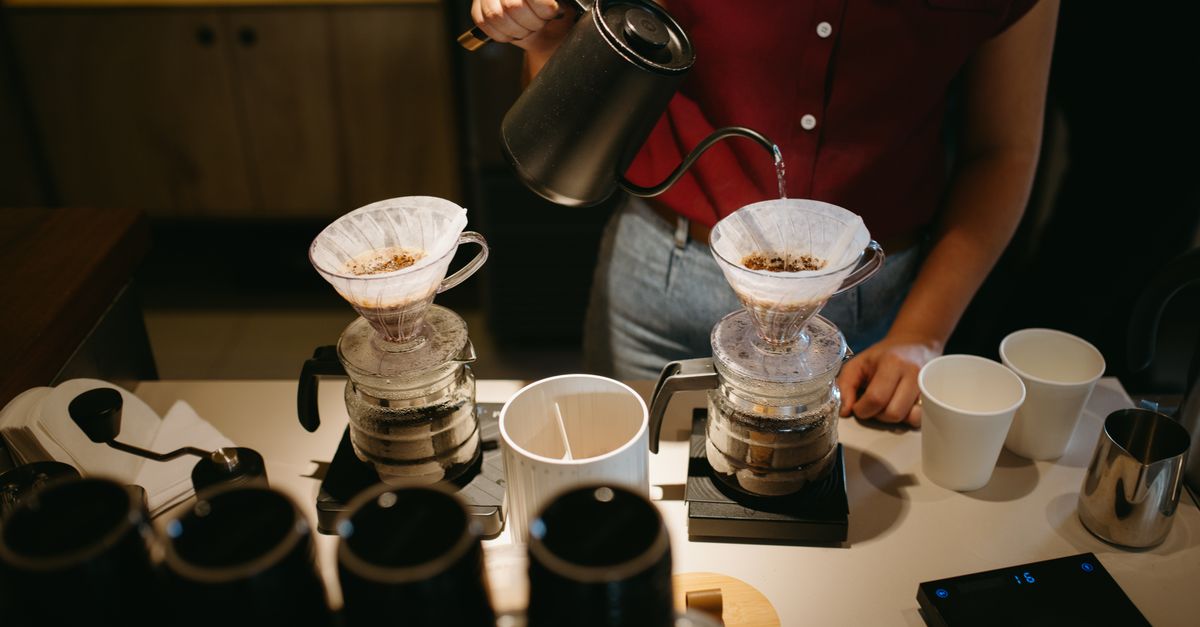
A gooseneck is a narrow, curved spout that exits the kettle low down and rises before bending over. Two consequences follow from that geometry.
Flow rate is low and predictable. Because the spout is narrow, water leaves as a thin stream rather than a surge, and the rate changes gradually as you tilt rather than suddenly. This lets you pour slowly enough to keep the coffee bed evenly saturated instead of blasting a hole through it.
The stream lands where you aim it. A standard kettle spout is wide and the water exits with lateral momentum, so it splashes and spreads. A gooseneck delivers a vertical stream you can place with reasonable precision — which is what makes the spiral pouring pattern used in V60 and Chemex brewing possible at all.
Why does that matter for the coffee? Pour over extraction depends on water passing evenly through the whole bed. If water channels down one side, that portion over-extracts and turns bitter while the rest under-extracts and tastes sour and thin — in the same cup. Even saturation is the entire game, and it is very difficult to achieve with a wide-spouted kettle.
Two design details worth checking: a counterweighted or well-positioned handle, because a full kettle poured slowly is surprisingly tiring on the wrist, and the spout height relative to the body, since a spout that exits very low continues pouring at a consistent rate as the kettle empties, while a high-exit spout slows noticeably.
Water Temperature: The Other Half of the Job
Brewing temperature strongly affects extraction. Water that is too cool under-extracts, giving a sour, weak, thin cup; water that is too hot over-extracts, giving bitterness and harshness. The generally recommended range for filter coffee is roughly 90°C to 96°C.
A standard UK kettle boils to 100°C and stops. That is too hot for most filter coffee, and the usual workaround — boil, then wait — is imprecise, because cooling rate depends on room temperature, kettle material, and how full it is. Waiting “about thirty seconds” is a guess.
A variable temperature kettle solves this by heating to a set point and stopping. Two levels of sophistication exist:
- Preset temperatures (typically five or six settings covering green tea through to coffee and boiling). Adequate for most people — if you can select 92°C, you have what you need.
- 1°C increments with PID control. PID is a control algorithm that approaches the target without overshooting and holds it steadily. This matters if you want to experiment systematically with temperature as a brewing variable, and it matters for light roasts, which generally benefit from hotter water near the top of the range.
The other genuinely useful feature is a hold function, which maintains the set temperature for a period — typically 30 to 60 minutes. This is more practical than it sounds: it lets you set the kettle going, grind, rinse the filter, and come back to water at exactly the right temperature rather than restarting.
A note on accuracy: the temperature a kettle displays is measured at its sensor, not at the spout, and the water cools slightly on its way into the brewer. Owner reviews frequently note a discrepancy of a couple of degrees between displayed and actual brewing temperature. If you are chasing precision, calibrate against a separate thermometer once and apply the offset.
The Best Gooseneck Kettles in Detail
Fellow Stagg EKG — the benchmark
The Fellow Stagg EKG is the kettle most specialist retailers recommend, and it earns that position on pour quality and control. According to Fellow it offers variable temperature in 1°C increments with PID control, a hold function of up to 60 minutes, and a counterbalanced handle designed to make slow pouring comfortable.
The spout is the part people rate most highly: it delivers a very fine, controllable stream with a predictable response to tilting, which makes it forgiving for anyone learning to pour. The build is solid, the display is clear, and there is a stopwatch built into some versions.
The criticisms are consistent across owner reviews: it is expensive for a kettle, the 0.9-litre capacity is small if you also want to make tea for several people, and some report the exterior finish marking over time. There is also a Pro version with additional features at a higher price. Expect around £160 to £200 at the time of writing.
Cosori Variable Temperature Gooseneck — most of the benefit, far less money
The Cosori gooseneck kettle is the value recommendation, and the argument for it is straightforward: it provides the two features that matter — a proper gooseneck spout and variable temperature — at roughly a third of the Stagg’s price.
According to Cosori it offers several preset temperatures covering the useful range for coffee and tea, a keep-warm function, and a stainless steel interior. The pour is good, if not quite as finely controllable as the Stagg, and for most home brewers the difference is not decisive.
Owner reviews are broadly positive on value, with the usual observations that build quality and finish are a step below premium options and that preset temperatures give less flexibility than 1°C control. If you are starting out in pour over and unsure how deep the hobby will go, this is the sensible first purchase. Expect around £60 to £90 at the time of writing.
Brewista Artisan — a strong middle option
The Brewista Artisan sits between the two above. According to Brewista it offers 1°C temperature control, a hold function, and a distinctive narrow spout, in a range of finishes.
Its particular characteristic is a very slow achievable flow rate, which some brewers prefer for delicate pours and which makes it well suited to small single-cup brews. It includes a built-in timer on most versions.
Owner reviews rate the pour and temperature accuracy well. Criticisms centre on the base and control interface feeling less refined than Fellow’s, and some report variability in build quality between units. Expect around £110 to £150 at the time of writing.
Hario Buono V60 — the stovetop classic
The Hario Buono is the kettle a great many people start with, and it remains a reasonable choice. It is a plain stovetop gooseneck kettle with no electronics — you heat it on a hob and judge the temperature yourself.
The spout is well designed and pours precisely, which is unsurprising given Hario designed it alongside the V60 dripper. It is cheap, it is simple, there is nothing to break, and it works on gas, electric and (in the stainless version) induction hobs.
The obvious limitation is temperature. Without a thermometer you are guessing, and the usual approach — bring to the boil, then rest for around 30 to 45 seconds — is approximate. Pairing it with a cheap digital thermometer costs little and closes most of the gap. Owner reviews are positive within those expectations, with occasional notes that the handle gets warm on a gas hob. Expect around £35 to £55 at the time of writing.
Timemore Fish Smart — good specification, competitive price
Timemore, better known for grinders and scales, makes a gooseneck kettle in its Fish range. The Fish Smart offers 1°C variable temperature control and a hold function at a price below the Fellow.
The spout design is aimed at slow, controlled pouring, and the aesthetic is deliberately minimal. For someone already using Timemore scales or a Timemore grinder, it makes a coherent set, though there is no functional advantage to matching brands.
Owner reviews rate performance well while noting, as with several Chinese-manufactured alternatives, that after-sales support and spare parts availability in the UK are less certain than with established Western brands. Expect around £90 to £130 at the time of writing.
Getting a Good Pour
The kettle is only half of it. A workable basic method for a V60:
- Rinse the paper filter with hot water and discard the rinse. This removes papery flavours and preheats the dripper and carafe.
- Add ground coffee — around 15g for a single mug — and level the bed.
- Bloom. Pour roughly twice the coffee’s weight in water (about 30g) to wet all the grounds, and wait 30 to 45 seconds. Fresh coffee releases carbon dioxide here, which is what causes the bubbling; if it does not bubble, the coffee is likely stale.
- Pour in stages in slow concentric circles, starting at the centre and spiralling outward without pouring directly onto the paper. Aim for a total of around 250g of water for a 15g dose.
- Aim for a total brew time of roughly 2 minutes 30 seconds to 3 minutes 30 seconds. Too fast suggests grinding finer; too slow, coarser.
Keep the stream thin and steady, keep the kettle spout close to the bed, and avoid pouring down the sides of the filter, which lets water bypass the coffee entirely.
FAQ
Do I really need a gooseneck kettle for pour over? For V60, Chemex, Kalita and similar manual filter methods, it makes a substantial difference. A standard kettle pours too fast and too wide to saturate the bed evenly, which causes channelling and produces a cup that is simultaneously bitter and sour. For immersion methods such as a cafetière or AeroPress, where the coffee steeps in the water rather than filtering through it, an ordinary kettle is perfectly adequate.
What temperature should I brew filter coffee at? Roughly 90°C to 96°C covers most coffee. Within that range, darker roasts generally suit the lower end, as they extract more readily and can turn bitter with very hot water, while lighter roasts usually benefit from the upper end to extract fully. If you have no variable temperature control, boiling and then resting the kettle for around 30 to 45 seconds gets you approximately into range, though the result depends on room temperature and how full the kettle is.
Is an electric gooseneck worth it over a stovetop one? The electric premium buys temperature control and convenience, not a better pour — a stovetop Hario Buono pours excellently. If you already own a thermometer and do not mind the extra step, a stovetop kettle plus thermometer achieves much the same result for far less money. The hold function is the feature most electric owners say they would miss, since it means the water is at the right temperature when you are ready rather than when the kettle finished.
Can I use a gooseneck kettle for tea? Yes, and variable temperature models are arguably more useful for tea than for coffee, because different teas want quite different temperatures — green tea around 70°C to 80°C, oolong around 85°C to 90°C, and black tea at or near boiling. The main practical drawback is capacity: most gooseneck kettles hold around 0.6 to 1 litre, which is small if you regularly make tea for several people, so many households keep an ordinary kettle alongside.