Bottomless Portafilter UK: The Cheapest Way to Fix Your Espresso
A UK guide to bottomless portafilters — what they diagnose, how to size one to your machine, reading the pour, and five specific picks.
Bottomless Portafilter UK: The Cheapest Way to Fix Your Espresso
A bottomless portafilter is not really an upgrade — it is a diagnostic instrument. Removing the spouts exposes the underside of the basket so you can watch exactly what the water is doing to your coffee, and it turns espresso from guesswork into something you can actually see and correct. For around thirty pounds it teaches more than any amount of reading. This guide is based on desk research: manufacturer specifications, retailer listings, and owner reviews on Amazon UK and specialist coffee retailers rather than first-hand testing. Below you will find a shortlist, a comparison table, notes on five options, and — most usefully — how to read what it shows you.
Quick Picks
| Best for | Model | Why we picked it |
|---|---|---|
| Best overall | IMS Competition bottomless | Well-made Italian body, usually supplied with a precision basket. |
| Best value | Normcore bottomless portafilter | Solid build and good handle options at a noticeably lower price. |
| Best for Sage/Breville | Sage-compatible 54mm bottomless | Fits the Barista range, which most 58mm options do not. |
Comparison Table
| Option | Size | Basket included | Handle | Approx price |
|---|---|---|---|---|
| IMS Competition | 58mm | Usually, precision | Wood or plastic | around £45–£80 |
| Normcore | 58mm / 54mm | Sometimes | Wood, resin | around £30–£50 |
| MHW-3BOMBER | 58mm | Sometimes | Wood, steel | around £35–£60 |
| Generic 54mm (Sage/Breville fit) | 54mm | Usually basic | Plastic or wood | around £20–£35 |
| E61 machine OEM bottomless | 58mm | No | Matches machine | around £50–£90 |
Prices are indicative and were correct at the time of writing. Always confirm the fit for your specific machine before buying.
Sizing: Get This Right or Nothing Else Matters
A portafilter must match your group head exactly. There is no adjustment and no adapter.
- 58mm — the commercial standard, used by most prosumer machines including Gaggia Classic, Rancilio Silvia, Lelit, ECM, Profitec, Rocket and E61 machines generally.
- 54mm — Sage/Breville machines (Barista Express, Barista Pro, Barista Touch, Bambino). These need a 54mm portafilter and a great many listings do not make that obvious.
- 51mm — several De’Longhi and entry-level machines.
- 49mm — some Flair and small manual machines.
Beyond diameter, check the ear and lug pattern. Portafilters lock into the group with tabs, and while 58mm is broadly standardised, some machines — particularly older or less common Italian models — have their own spacing. If you have anything unusual, buy from a retailer who lists compatibility by machine model.
For Sage/Breville owners specifically: the standard machines ship with pressurised (dual-wall) baskets, which are designed to create artificial pressure and will not work usefully with a bottomless portafilter. Going bottomless means also moving to non-pressurised (single-wall) baskets, and that in turn means you need a grinder capable of a genuine espresso grind. If your grinder cannot do that, the bottomless portafilter will simply show you a mess.
What It Actually Shows You
This is the point of the thing. With the spouts gone, you watch the bottom of the puck through the whole shot.
A good extraction looks like this: after a couple of seconds the basket surface darkens evenly, then droplets appear across the whole base, then those merge into a single central stream that falls straight into the cup, dark and syrupy, sometimes described as “mousetail”. The flow is even and unhurried.
Channelling looks completely different and is unmistakable once seen: a thin, pale jet squirting sideways or spraying out at an angle, often accompanied by the shot running fast and tasting thin and sour. That jet is water finding a low-resistance path and racing through it, over-extracting that channel while the rest of the puck barely gets wet.
Common patterns and what they mean:
- A single side jet, same place every time. Usually a tilted tamp, or a worn or damaged basket. Check you are tamping level.
- Spraying around the edge. Often an undersized tamper leaving loose coffee at the basket wall, or an under-dosed basket.
- Multiple jets everywhere, very fast shot. Grind far too coarse, or badly clumped coffee that was never evenly distributed.
- Nothing for ages, then a violent spurt. Grind too fine or dose too high — the puck is choking and then failing.
- Even droplets but a very slow shot. Grind slightly too fine. This is a good problem; it means your prep is sound and only the grind needs moving.
The diagnostic value is that these are all invisible with a spouted portafilter. You taste a bad shot and guess. With a bottomless one you see the cause.
Fixing What You See
Work in this order, changing one thing at a time:
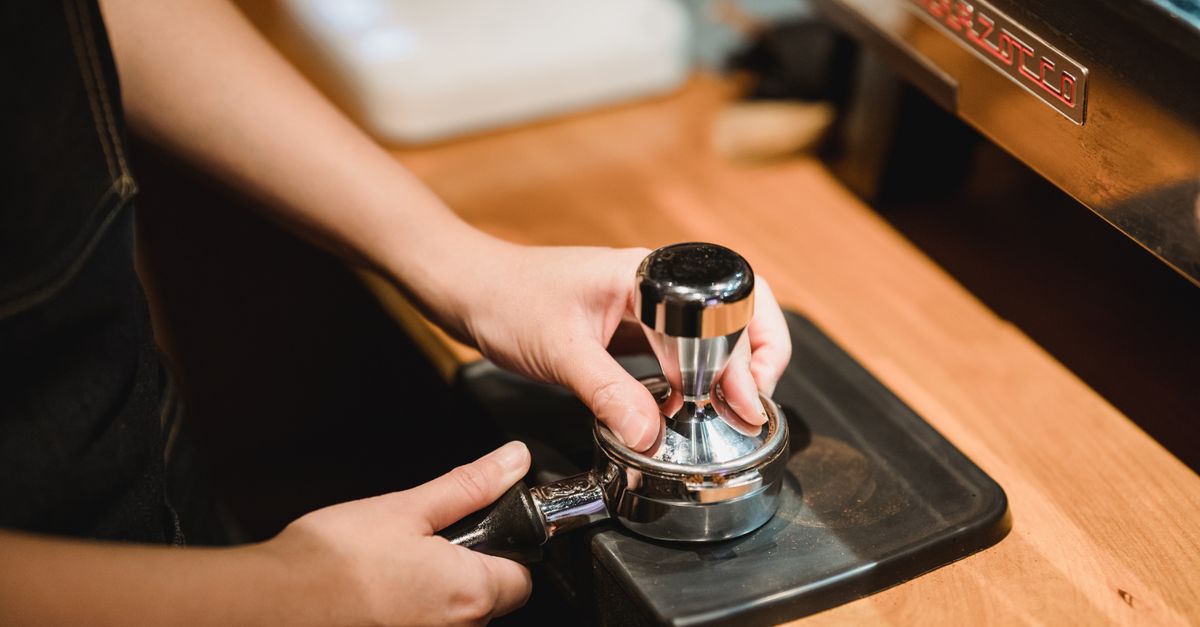
- Check the tamper size. A 58mm group generally wants a 58.3mm or 58.5mm tamper. Undersized tampers leave a loose ring at the wall and cause edge channelling — an extremely common and easily fixed fault.
- Break up clumps. Stirring the dry grounds with a fine-needled WDT tool before tamping is the single most effective fix for scattered channelling.
- Tamp level, not hard. A tilted tamp guarantees a side jet. Pressure matters far less than levelness.
- Weigh the dose. Consistency is impossible without it. Match the dose to the basket’s rating.
- Then adjust the grind, and only then, so you can tell what actually changed.
- Check the basket. Cheap stamped baskets have uneven hole patterns. A precision basket (IMS, VST, Pesado) genuinely improves flow evenness and is worth having once the rest is right.
Two practical warnings. A bottomless portafilter sprays when things go wrong, so expect to wipe the machine and worktop while learning. And never pull a shot with a bottomless portafilter and no basket in it — you will get scalding water everywhere.
The Options in Detail
IMS Competition — the quality choice
IMS is an Italian filter manufacturer whose baskets are used across the specialty industry, and its bottomless portafilters are generally regarded as the benchmark. They are typically supplied with an IMS precision basket, which is the part that matters most for flow evenness.
The body is well finished, heavy enough to hold heat, and available with various handle materials. Owner reviews consistently rate build and fit. The objection is price — you are paying a genuine premium over generic alternatives that are dimensionally similar. Expect around £45 to £80 at the time of writing depending on handle and basket.
Normcore — the value benchmark
Normcore has built a strong reputation for making decent espresso accessories at accessible prices, and its bottomless portafilters are the usual value recommendation. Available in 58mm and 54mm, with wood or resin handle options.
Owner reviews are broadly positive on fit and finish for the price, with the main caveats being that basket quality varies by bundle and that the handle finish is less refined than premium options. For most home users this is the sensible purchase. Expect around £30 to £50 at the time of writing.
MHW-3BOMBER — well finished, mid-priced
MHW-3BOMBER produces a range of espresso tools with a design-led approach, including bottomless portafilters in several finishes. Build quality is generally well reviewed and the aesthetics are a draw for some.
As with Normcore, check exactly what basket is included, and verify machine compatibility before ordering. Expect around £35 to £60 at the time of writing.
54mm options for Sage/Breville
Sage/Breville owners are served by a range of 54mm bottomless portafilters from various makers. The important thing is not brand but the combination: a 54mm bottomless portafilter plus non-pressurised baskets plus a grinder that can actually grind fine enough. Buying the portafilter alone, and keeping the pressurised baskets, achieves nothing.
Owner reviews for the budget end of this category are mixed on handle quality but generally fine on fit. Expect around £20 to £35 at the time of writing.
OEM bottomless from your machine’s maker
Several manufacturers — Lelit, ECM, Profitec, Rocket among them — sell their own bottomless portafilters designed for their machines. They cost more than generics but guarantee fit, handle style and finish match, which matters if you care about the machine looking right. Expect around £50 to £90 at the time of writing.
FAQ
What does a bottomless portafilter actually do? It removes the spouts so you can see the underside of the coffee basket during extraction. That makes it a diagnostic tool rather than a performance upgrade — it does not by itself improve the coffee, but it shows you exactly why a shot is going wrong. Channelling, which is the most common cause of espresso that tastes both bitter and sour, is completely invisible with a normal spouted portafilter and unmistakable with a bottomless one.
Will a bottomless portafilter fit my machine? Only if you buy the right size. Most prosumer machines use 58mm; Sage/Breville machines use 54mm; several De’Longhi and entry-level machines use 51mm. Measure or check your machine model rather than assuming, and buy from a retailer listing compatibility by model, since ear and lug spacing varies on some less common machines. Sage owners also need to switch to non-pressurised baskets for it to work at all.
Why is my espresso spraying everywhere from the bottomless portafilter? That is channelling, and the portafilter is doing its job by showing it to you. Water is finding a low-resistance route through the puck instead of passing through evenly. The usual causes, in order of likelihood: an undersized tamper leaving loose coffee at the basket wall, clumped grounds that were never distributed, a tilted tamp, or an inconsistent dose. Fix those before touching the grind, and change one thing at a time.
Do I need a precision basket as well? Not immediately. Work through tamper sizing, distribution and tamping technique first, since those account for most channelling. Once your prep is consistent and you are still seeing uneven flow, a precision basket from IMS, VST or Pesado — which has a more uniform hole pattern than cheaper stamped baskets — is a worthwhile next step. Many bottomless portafilters are sold bundled with one, which is a reasonable way to buy both.