Espresso Mugs: The Best Espresso Cups for UK Home Baristas in 2026
A shot of espresso can be pulled perfectly and still arrive at your lips lukewarm, flat and crema-less — and the culprit is usually the vessel, not the…
Espresso Mugs: The Best Espresso Cups for UK Home Baristas in 2026
A shot of espresso can be pulled perfectly and still arrive at your lips lukewarm, flat and crema-less — and the culprit is usually the vessel, not the machine. Most people searching for espresso mugs are really shopping for an espresso cup: a small, thick-walled vessel scaled to a 25–35 ml single shot. Get the size and material right and a modest home setup punches well above its weight. Get it wrong — a 150 ml mug, say — and the crema collapses and the drink cools within a minute or two.
This guide compares the espresso cups and small mugs UK buyers realistically choose between in 2026, working from manufacturer specifications and care pages, expert and community consensus, and published retailer listings rather than product photography. It covers capacity, materials, moka-pot maths, machine clearance and the care trap that quietly ruins double-walled glass.
Quick Picks
| Pick | Product | Best for | Typical UK price |
|---|---|---|---|
| Best overall | Le Creuset Stoneware Espresso Cups | Heat retention, colour choice, dishwasher-safe stoneware | around £18–22 per cup |
| Best glass | Bodum Pavina Double Wall Glass | Seeing the crema, cool to hold, first machines | around £15–20 per pair |
| Best set for moka owners | Bialetti Porcelain Espresso Cups | Matched six-cup sets to go with a moka pot | around £15–25 per six-cup set |
| Best design | illy Art Collection Espresso Cups | Gifting, collecting, 90 ml porcelain | around £20–30 per set |
| Best budget | IKEA EGENTLIG | Trying double-wall glass for very little | around £6–8 for two |
If you want the short answer, that table is it. What follows explains why — and where a low price hides a compromise.
What the Standard Actually Says
The Specialty Coffee Association (SCA) defines an espresso beverage as a 25–35 ml single shot, and specifies a service vessel of 60–90 ml. That headroom above the liquid isn’t decorative: it gives the crema somewhere to sit so it doesn’t spill over the rim the moment you pick the cup up, and it slows the rate at which the surface cools.
That single standard explains why “espresso mug” is a slightly misleading search term. What you want is a cup sized between roughly 60 ml and 120 ml, depending on whether you drink ristretti, singles or something closer to a cortado. Anything past about 150 ml is a mug in the flat-white sense — pleasant, but it will cool a short shot too quickly and spread the crema thin.
How to Choose an Espresso Cup
Capacity: the specification nobody reads properly
Espresso cups are sold in a handful of standard sizes, and each suits a different drink:
- 60–70 ml — the traditional Italian tazzina. Correct for a single 25–30 ml shot with crema headroom. Tight if you drink doubles.
- 80–90 ml — the sweet spot for most home baristas. A Joybuy buying guide notes that an 80 ml cup gives extra room for crema, sugar or a slightly larger coffee.
- 100–120 ml — flexible. The same Joybuy guide points out that a 120 ml cup also suits moka coffee, Turkish coffee, small desserts or tastings, which makes it the better choice if the cup has to earn its place in a small kitchen.
- 150 ml and up — no longer an espresso cup. Fine for a flat white or a lungo, but it will cool a short shot too fast.
The most common buying mistake, according to that same Joybuy guide, is confusing nominal capacity with usable serving size. A stated figure rarely reflects what you can practically pour without slopping it over the rim. Assume you need roughly 20 ml of clearance above whatever you’re serving.
The material question: porcelain, stoneware, earthenware
First, a terminology fix that trips up a lot of buying guides: porcelain is ceramic. Ceramic is the umbrella term covering porcelain, stoneware and earthenware alike. The useful contrast isn’t “ceramic versus porcelain” — it’s porcelain versus stoneware versus earthenware.
Porcelain is fired at approximately 1,200–1,400 °C, which vitrifies the body into something hard and dense with very low porosity. Earthenware is fired at roughly 1,000–1,150 °C, leaving it more porous and softer. Stoneware sits between the two and is generally the more robust everyday choice.
One myth worth retiring: porcelain is not straightforwardly “more chip-resistant” than earthenware. It is harder and denser, but it is also more brittle under impact. A knock that would dent an earthenware rim can take a chip out of a porcelain one. If your cups live next to a sink and get handled roughly, that matters more than the firing temperature.
For espresso specifically, thicker-walled porcelain and stoneware both absorb heat from the shot — which is an advantage if you pre-heat and a liability if you don’t.
The double-wall trap
Double-walled glass looks superb and holds temperature well, because the vacuum seal between the two walls is doing the insulation. That same construction creates two practical problems.
The first is care. Vacuum-sealed double-wall glass is hand-wash only. Dishwasher heat degrades the vacuum seal, which is why both Bodum’s and IKEA’s care instructions specify hand washing for their double-walled ranges. Once the seal goes, the cup stops insulating and starts looking foggy.
The second is water ingress. Some double-wall bases have an unsealed aperture rather than a fully sealed vacuum. In a dishwasher, water gets in through that opening and sits inside the wall gap — where it can’t be dried and where mould eventually grows. There is no way to clean it out.
Switching to a plain stoneware cup with a pre-heat gives you the same thermal benefit without that risk.
Pre-heating: yes for stoneware, pointless for double-wall
Pre-heating is genuinely useful for stoneware and porcelain. Fill the cup with hot water from the kettle — around 60–70 °C is plenty — and leave it for 30 seconds while you grind and tamp. Pour it out, pull your shot into the warm cup, and the thermal mass of the walls buffers the temperature instead of stripping it from the coffee.
For double-walled glass, pre-heating is largely redundant: insulation is the design goal, so retained heat is already the function the cup performs. Running hot water through it adds a step and no benefit.
One warning that comes straight from Le Creuset’s own care page: do not microwave stoneware. Use kettle water for pre-heating instead.
Machine clearance: the table nobody publishes
This is where a cup that looks perfect online fails at home. Taller cups simply won’t fit between the drip tray and the group spout on a compact machine. Manufacture-stated clearances for three popular UK home machines:
| Machine | Approximate clearance (drip tray to spout) |
|---|---|
| De’Longhi Dedica | ~70 mm |
| Sage Bambino Plus | ~85 mm |
| Gaggia Classic Pro | ~95 mm |
For reference, the 80 ml Bodum Pavina stands about 65 mm tall according to Bodum’s spec sheet — so it clears even the tightest of those three, though only by a few millimetres on the Dedica. If you’re buying for a compact machine, check the cup’s height against that ~70 mm figure before anything else.
Price bands
UK espresso cups cluster into three bands:
- Around £6–10 — IKEA’s EGENTLIG and basic marketplace porcelain. Perfectly acceptable for moka use.
- Around £15–22 — Bodum Pavina, Bialetti’s porcelain sets and ProCook stoneware.
- Around £18–25 and up — Le Creuset per cup and illy Art Collection sets.
To put that in perspective: Le Creuset works out at roughly 3–4× the per-cup cost of IKEA’s EGENTLIG. That premium is only justifiable on heat retention and longevity grounds — thick stoneware holds temperature better and survives years of daily use. If neither of those matters to you, the budget band is not a compromise.
The Best Espresso Cups and Mugs in the UK for 2026
Le Creuset Stoneware Espresso Cups — best overall
Best for: buyers who want a proper thermal buffer, a colour that matches their kitchen, and a cup that goes in the dishwasher without a second thought.
Each cup holds 70 ml, sold individually or in pairs, and is made in Le Creuset’s stoneware body — thick-walled, heavy in the hand and noticeably slower to cool than thin porcelain. Le Creuset’s care page lists them as dishwasher-safe. The colour range is one of the widest of any cup in this roundup, with the current line-up listed on Le Creuset’s UK site, so you can match a specific shade rather than settle for white.
The catch: the care page advises against microwaving stoneware, and at around £18–22 per cup you’re paying roughly three to four times what IKEA charges. That money buys heat retention and longevity, not a better-tasting shot.
Verdict: the most sensible long-term buy if you pre-heat properly and want a cup that still looks right in five years.
Where to buy: Le Creuset’s UK site and its own stores.
Bodum Pavina Double Wall Glass — best glass
Best for: anyone who wants to watch the crema form, and anyone pulling shots on a first machine who finds hot cups uncomfortable to hold.
These come in 80 ml and 100 ml variants, made from borosilicate glass with a double wall. The 80 ml version measures roughly 65 mm tall, which clears the De’Longhi Dedica, Sage Bambino Plus and Gaggia Classic Pro clearances listed above. The outer wall stays cool to the touch, so there’s no burnt-fingertip moment on the way to the table, and the transparency makes it genuinely useful for judging crema colour and persistence.
The catch: Bodum’s care instructions say hand-wash only, because dishwasher heat degrades the vacuum seal — and once that seal fails, the insulation is gone. That’s the double-wall trade-off, not a fault specific to Bodum.
Verdict: the best glass option in the UK, provided you accept it will never see the inside of a dishwasher.
Where to buy: Bodum’s own site and John Lewis.
illy Art Collection Espresso Cups — best design
Best for: gifting, collecting, or a kitchen where the cup is part of the table setting rather than pure utility.
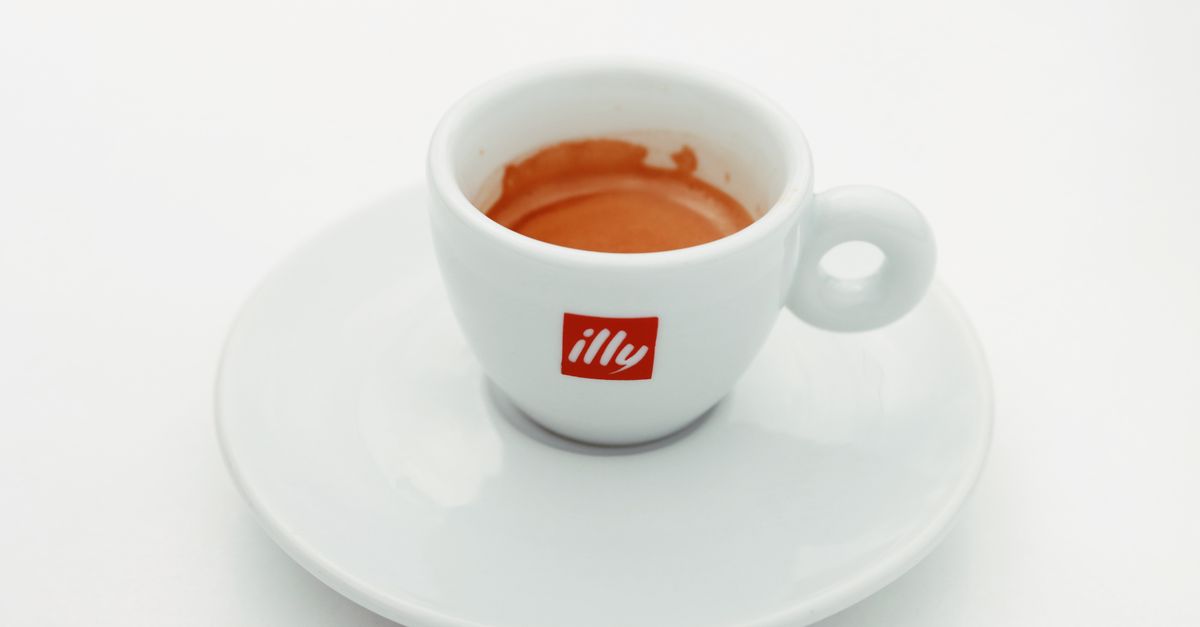
These are 90 ml porcelain cups, typically sold as sets of two or six, with the price depending on which size of set you choose. The Art Collection format means the decors change with each edition, so the range you see today may not be the range available next season. At 90 ml they sit squarely in the SCA’s 60–90 ml service range and comfortably handle a double shot.
The catch: availability is inherently episodic — art editions are released and retired. And the porcelain, while hard and dense, is more brittle under impact than earthenware, so treat them as tableware rather than workhorses.
Verdict: the pick if the cup needs to look as good as the shot tastes, and you don’t mind buying by edition.
Where to buy: Selfridges and illy UK directly.
Bialetti Porcelain Espresso Cups — best set for moka owners
Best for: anyone running a Bialetti moka pot who wants matched cups to pour into, in one purchase.
Bialetti’s porcelain cups are sold in sets, and the range spans both 70 ml and 90 ml depending on which SKU you order — so check the individual product page rather than assuming a size. Construction is porcelain, which means a hard, dense body and a fairly fine rim.
The catch: that SKU-dependent sizing. Two listings that look near-identical can differ by 20 ml of capacity, which is the difference between a cup that suits a single shot and one that suits a double. Read the specification.
Verdict: the obvious pairing for a moka pot, and usually the cheapest way to get six matching cups.
Where to buy: Amazon UK and John Lewis.
IKEA EGENTLIG — best budget glass
Best for: testing whether you actually like double-wall glass before spending more, or kitting out a small kitchen cheaply.
The EGENTLIG is a 60 ml clear double-wall glass, sold around £6–8 for two. At 60 ml it sits at the very bottom of the SCA’s service range — correct for a traditional single, tight for anything larger. IKEA’s care label specifies hand washing, for the same vacuum-seal reason as any other double-wall glass.
The catch: 60 ml leaves very little margin if you drink doubles, and the same hand-wash-only rule applies. There’s also the unsealed-aperture risk that affects some double-wall bases — water ingress and mould inside the wall gap.
Verdict: unbeatable value for a single-shot drinker who wants the look of double-wall glass without the Le Creuset outlay.
Where to buy: IKEA stores and the IKEA UK site.
Denby Stoneware Sets — best for a matching table
Best for: households building a coherent set of ceramics who want cups that coordinate with plates and bowls.
Denby is a UK-specific name in the stoneware market, and its ranges are stocked through its own site as well as John Lewis. Because Denby’s cup capacities and prices shift with each collection, the current capacity and price are best confirmed against the specific range on Denby’s own pages rather than assumed from a generic listing.
The catch: the range-by-range variation. You’re buying a look and a collection to build on, not a fixed specification you can compare like-for-like against other cups here.
Verdict: the right call if the cup has to match the rest of the dinnerware, less so if you’re optimising capacity per pound.
Where to buy: Denby’s own site and John Lewis.
ProCook Own-Brand Stoneware Sets — best value stoneware
Best for: buyers who want the heat-holding properties of stoneware without Le Creuset pricing.
ProCook’s own-brand stoneware sets sit in the around £15–22 band, which puts them alongside the Bodum Pavina and Bialetti sets. Like Denby, ProCook’s capacity and pricing vary by collection, so it’s worth confirming the current specification on the product page before ordering.
The catch: less colour choice and less of a resale/second-hand market than the heritage brands — but the practical performance is in the same territory.
Verdict: the sensible mid-band stoneware buy, especially if you want to pre-heat and get the thermal benefit without paying per-cup Le Creuset money.
Where to buy: ProCook’s own site and John Lewis.
Sizing a Moka Pot: The Table Nobody Publishes
If you own a Bialetti moka pot, the number on the box is not the number of espresso cups you’ll fill. Moka ratings count small demitasse servings rather than full mugs, which is why a “6-cup” pot so often disappoints people who’ve bought six cups to match.
Here’s what Bialetti’s UK product spec pages list per model, measured against a practical 90 ml espresso cup:
| Bialetti model rating | Manufacturer-claimed yield | Practical 90 ml cup fills |
|---|---|---|
| 3-cup | ~130 ml | 1 full, 1 partial |
| 6-cup | ~270 ml | about 3 |
| 9-cup | ~420 ml | about 4–5 |
Read that middle row carefully before you buy: a 6-cup pot yields roughly 270 ml, which is about three 90 ml cups — not six. If you want six filled cups at once, you need the 9-cup, and even then you’ll get about four to five fills at 90 ml. If your cups are 60 ml rather than 90 ml, you’ll fill more of them, but right to the rim.
Espresso Cups in the UK: Practical and Regulatory Notes
The SCA’s 60–90 ml service range is the single most useful benchmark when comparing listings, because it’s an independent standard rather than a manufacturer’s marketing figure. If a cup falls inside that range, it will serve a standard 25–35 ml single shot properly; if it falls well outside it, no amount of branding changes the physics.
On care, the rule splits cleanly by material. Stoneware cups that a manufacturer lists as dishwasher-safe — the Le Creuset range among them — can go in the machine. Double-walled glass from Bodum and IKEA cannot, per those brands’ own care instructions, because dishwasher heat damages the vacuum seal.
And on pre-heating, remember the split: kettle water at around 60–70 °C for 30 seconds for stoneware and porcelain, nothing at all for double-walled glass, and never the microwave for stoneware.
Frequently Asked Questions
How many ml is a standard espresso cup? The Specialty Coffee Association specifies a 60–90 ml service vessel for a standard 25–35 ml single shot. That range exists to leave headroom above the crema, not to give you room for milk. Cups at 60 ml are traditional; cups at 90 ml are more forgiving.
What size cup should I use for a double espresso? Aim for 80–100 ml of usable capacity. A double shot is roughly twice the volume of a single, and you still want clearance above the crema so it doesn’t spill over the rim when you lift the cup. An 80 ml cup is the most commonly recommended sweet spot, with 100 ml giving you slack for sugar or a splash of milk.
Are espresso cups dishwasher safe? It depends entirely on the material and construction. Le Creuset lists its stoneware espresso cups as dishwasher-safe on its care page. Vacuum-sealed double-walled glass from Bodum and IKEA is hand-wash only, because dishwasher heat degrades the seal — and on models with an unsealed base aperture, water can get into the wall gap where it can’t be dried out.
Do espresso cups need pre-heating? Yes for stoneware and porcelain, where a cold, thick wall will pull heat out of a 30 ml shot almost immediately. Fill the cup with hot water from the kettle at around 60–70 °C, leave it 30 seconds, then empty it before pulling the shot. For double-walled glass, pre-heating is redundant — the insulation already does that job.
What’s the difference between porcelain, stoneware and earthenware? All three are ceramics; porcelain and earthenware are simply fired at different temperatures. Porcelain is fired at approximately 1,200–1,400 °C, earthenware at roughly 1,000–1,150 °C, with stoneware in between. Porcelain ends up harder and denser, but it’s also more brittle under impact than earthenware — so it isn’t automatically the more chip-resistant choice.
How many espresso cups will my moka pot actually fill? Fewer than the name suggests. Bialetti’s UK spec pages list roughly 130 ml for a 3-cup, about 270 ml for a 6-cup and around 420 ml for a 9-cup. Measured into 90 ml cups, that’s one full and one partial, about three, and about four to five respectively.
Can I microwave a stoneware espresso cup to warm it? Le Creuset’s care page explicitly advises against microwaving its stoneware. Use hot water from the kettle instead — it’s faster, safer for the glaze, and gives you the same pre-heated cup in about 30 seconds.
The Short Version
Buy to the SCA’s 60–90 ml service range and you’ll rarely go wrong. Choose stoneware or porcelain — Le Creuset from around £18–22 per cup, ProCook around £15–22, Bialetti sets around £15–25 — if you want heat retention and dishwasher convenience, and commit to pre-heating. Choose double-walled glass — Bodum Pavina around £15–20 per pair, IKEA EGENTLIG around £6–8 for two — if you want to see the crema and don’t mind hand-washing forever. And whatever you buy, check the height against your machine’s clearance before you order, not after.