Espresso Powder: The Best Instant Espresso Powder for Baking in the UK in 2026
A teaspoon of espresso powder is the smallest change you can make to a chocolate cake, and the one people notice most.
Espresso Powder: The Best Instant Espresso Powder for Baking in the UK in 2026
A teaspoon of espresso powder is the smallest change you can make to a chocolate cake, and the one people notice most. The concentrated, roasted bitterness of dried coffee flatters cocoa instead of competing with it: chocolate tastes more like itself, and a slightly heavier hand turns a buttercream or a sauce into a proper mocha.
The catch is supply. In the United States a dedicated jar of baking espresso powder is a supermarket staple. In the UK it is largely an import, bought in 57 g and 85 g jars from third-party Amazon UK sellers at prices that look trivial per jar and steep per gram. Many British bakers are better served by an instant espresso from the ordinary coffee aisle — and this guide is built to show you why. Every price below is normalised to £ per 100 g, so jars of different sizes can be compared honestly, and the UK-domestic substitutes named here come with the owner-report evidence behind them rather than a manufacturer’s marketing claim.
Prices were checked in July 2026 and are approximate: imported stock and third-party pricing move around, so treat them as a guide and check the live listing. Where a manufacturer does not publish a figure — granulation, for instance — this guide says so rather than guessing.
Quick Picks
| Product | Best for | Typical UK price |
|---|---|---|
| Medaglia d’Oro Instant Espresso Coffee | Best overall | Around £10–£12 per 57 g jar (approximately £18–£21 per 100 g) |
| King Arthur Espresso Powder | Best for baking | Typically around £14–£16 for 85 g (approximately £16–£19 per 100 g) |
| Café Bustelo Instant Espresso | Boldest flavour for the smallest outlay | Around £7–£9 for the 36 g sachet or 6 oz jar |
| Nescafé Azera Intenso | Best UK-domestic substitute | Typically lower cost per 100 g; stocked at Ocado, Amazon UK and Waitrose |
| Lavazza Prontissimo Intenso | UK-domestic substitute | Typically lower cost per 100 g; stocked at Ocado, Amazon UK and Waitrose |
| Starbucks VIA Italian Roast | UK-domestic substitute | Typically lower cost per 100 g; stocked at Ocado, Amazon UK and Waitrose |
| Percol Americano | UK-domestic substitute | Typically lower cost per 100 g; stocked at Ocado, Amazon UK and Waitrose |
What Espresso Powder Actually Is
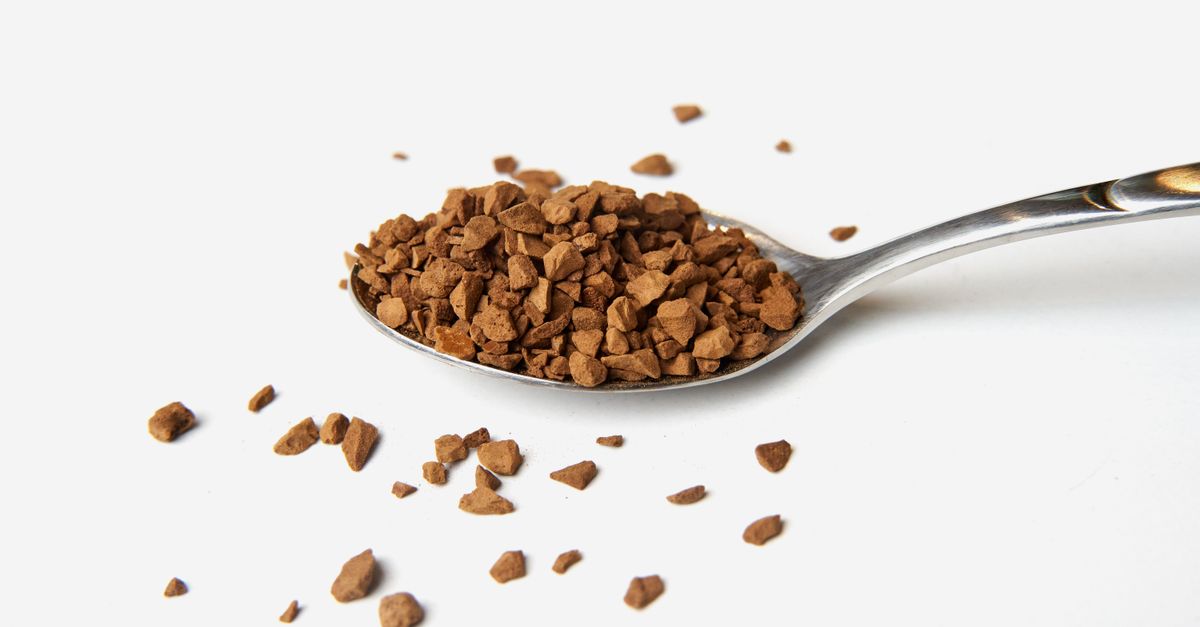
Espresso powder is brewed coffee that has been dried and then milled to a fine powder. That sequence — brewed first, dried second — is the whole point, and it is what separates it from everything else sold as coffee.
Because the beans have already given up their soluble solids to water once, there is nothing left to extract. A ground coffee bean stirred into a batter keeps releasing acids and bitter compounds as the bake sits in the oven; a powder has already surrendered those to water during brewing, so it simply dissolves and contributes flavour. In practice that means you can stir it straight into a dry flour mix, a cold frosting or a warm sauce without blooming it in hot water first, without straining it, and without it turning a vanilla sponge grey with grit.
The terminology, once
Recipes say “espresso powder”, shop listings say “instant espresso”. This guide uses instant espresso powder as the working label because it is the most accurate: the product is an instant coffee, and its baking use is secondary.
There are three drying processes you may see named, and they behave differently:
- Spray-dried — fine particles produced by spraying liquid coffee into hot air. Dissolves fast, but the heat can drive off some of the aromatic compounds.
- Freeze-dried — the coffee is frozen and the ice removed under vacuum, giving coarser crystals with better flavour retention.
- Agglomerated — small particles fused into larger granules so they dissolve evenly without dusting.
Manufacturers rarely publish which process they use for a given jar, so treat a seller’s process claim as unconfirmed unless the brand states it outright.
It is also worth knowing that “baking-grade” is marketing language, not a regulated category. No UK regulation draws a line between a powder sold for baking and one sold for drinking. They are the same product, marketed two different ways.
Espresso powder vs instant coffee vs ground espresso
These three get confused constantly, and the difference decides whether your frosting is smooth or gritty:
- Instant espresso powder — brewed, dried and finely milled. Dissolves almost instantly, intensely flavoured, sold in small jars. This is what a baking recipe means.
- Instant coffee granules — also brewed and dried, but typically coarser and milder. Perfectly usable as a substitute, especially if you grind the granules finer, but you will usually need more of them to taste the difference.
- Finely ground espresso beans — what you grind for a shot. They never dissolve. In brownies and some biscuits a small quantity adds a pleasant texture, but in a sponge or a frosting it reads as grit.
How fine is it, really?
Neither King Arthur Baking nor Medaglia d’Oro publishes mesh or micron specifications publicly, so any precise fineness figure you see quoted is unsourced. The only defensible statement is the one owners keep making: both are finer than most instant granules, which is why they dissolve cleanly into cold frosting rather than leaving speckles.
Check the ingredient declaration
Before repeating any “clean” or “additive-free” claim, open the individual product listing and read the ingredients. Some instant espresso powders are 100% coffee. Others contain anti-caking agents, and formulations differ between brands — and between import labels for the same brand. It is a per-listing check, not a category-wide fact.
Two of these are drinking coffees first
Medaglia d’Oro and Café Bustelo are sold primarily as instant drinks, in Italian-style and Latin-American instant coffee ranges respectively; their use in baking is secondary. It is more honest to think of them as instant espresso that doubles as a baking ingredient than as purpose-built baking products. King Arthur Espresso Powder is the exception, sold with baking as its stated job.
How to Choose an Espresso Powder in the UK
Compare the price per 100 g, not the price per jar
Jars are tiny and sizes differ, so headline prices are close to meaningless. A 57 g jar at around £10–£12 is approximately £18–£21 per 100 g. An 85 g jar at typically around £14–£16 is approximately £16–£19 per 100 g. A 36 g sachet at around £7–£9 looks like the cheapest buy on the shelf until you work out the unit price — it often lands higher per 100 g than the 57 g Medaglia d’Oro once import handling is added to a very small format. Same ingredient, very different value.
Read the ingredient declaration
Two products with near-identical names can differ in whether they contain anti-caking agents. If that matters to you, it has to be checked listing by listing.
Check the best-before date on imports
Imported jars reach UK third-party sellers through long supply chains, and stock is patchy. A short best-before date on a 57 g jar you will use two teaspoons at a time is a real risk.
Decide between sachet and jar
Sachets are a sensible way to try the ingredient before committing. Jars are better for regular baking, partly because the powder is hygroscopic and a resealable jar keeps moisture out more reliably (more on that below).
Start with one to two teaspoons
King Arthur Baking’s own product page for its espresso powder suggests one to two teaspoons to deepen chocolate in baked goods, frostings and sauces. Push the dose higher and you are making mocha rather than intensifying chocolate. For scale, King Arthur’s mocha whoopie pie recipe calls for 3 tablespoons of espresso powder across one batch — a quantity the recipe itself notes makes the cakes very strongly coffee-flavoured. If you are new to the ingredient, start at the low end and build up.
Why it lifts chocolate at all
Coffee and chocolate share a class of roasted, bitter aromatic compounds — pyrazines and furans, formed by Maillard browning and roasting. Harold McGee’s On Food and Cooking (2004 edition) covers coffee-roasting chemistry in detail. The safe, mechanism-free version of the claim is simply that coffee intensifies chocolate flavour, which is why the technique appears in recipe after recipe without explanation.
Medaglia d’Oro Instant Espresso Coffee — Best Overall
Who it’s for: the baker who wants one small jar that behaves properly both in a cup and in a cake.
This is a dark, Italian-style instant espresso sold in a 2 oz / 57 g jar. It is a drinking coffee first, so expect a genuinely bitter, roasted edge — which is exactly what gives it enough backbone to register against cocoa and dark chocolate in a brownie or a buttercream.
- Format: 57 g (2 oz) jar
- Typical UK price: around £10–£12 per jar from Amazon UK third-party sellers
- Normalised cost: approximately £18–£21 per 100 g
- Use: one to two teaspoons to deepen chocolate; more for mocha
Caveat: it is the most expensive of the three imports per 100 g, and availability on Amazon UK is patchy because these are third-party listings rather than first-party stock. Check the best-before date before buying.
Where to buy: Amazon UK third-party sellers.
Verdict: the default pick if you want a single jar that works in a cup and in a cake.
King Arthur Espresso Powder — Best for Baking
Who it’s for: anyone following American baking recipes, where this is the reference product.
King Arthur Espresso Powder is the powder most US recipes assume you have, and it is the only one of the three imports sold with baking as its stated purpose rather than as a drink. It arrives as a 3 oz / 85 g jar.
- Format: 85 g (3 oz) jar
- Typical UK price: typically around £14–£16 as an Amazon UK import
- Normalised cost: approximately £16–£19 per 100 g
- Dosing guidance: King Arthur Baking’s own product page suggests one to two teaspoons to deepen chocolate
Standout strength: it dissolves cleanly into cold mixtures, and owner consensus consistently describes it as finer than most instant granules — the practical benefit being a frosting with no detectable grit. That is a peer comparison, not a published specification: King Arthur does not publish mesh or micron figures.
Caveat: it is an import only, so both price and availability swing with shipping, and the largest jar of the three is still only 85 g. That said, it works out cheaper per 100 g than Medaglia d’Oro — approximately £16–£19 against £18–£21.
Where to buy: Amazon UK, as an import listing.
Verdict: the safest choice if you are baking from American recipes or want the cleanest dissolve.
Café Bustelo Instant Espresso — Bold, Small, and Not the Value It Looks
Who it’s for: the baker who wants to test the ingredient with the smallest possible outlay.
Café Bustelo is a bold, dark instant espresso, sold as a 36 g sachet or a 6 oz jar, and it is forgiving in frostings and sauces where a strong roast is welcome.
- Format: 36 g sachet or 6 oz jar
- Typical UK price: around £7–£9 for the small format from Amazon UK
- Normalised cost: often higher per 100 g than Medaglia d’Oro once import handling is added
Caveat — and it is the important one: the low headline price reflects the sachet size, not the value. The “best value” badge is unearned in the UK context. A 36 g format carries the same fixed import and handling costs over far fewer grams, which is why the unit price climbs above the larger Medaglia d’Oro jar.
Where to buy: Amazon UK.
Verdict: a good way to try the ingredient cheaply, provided you do not mistake a small jar for a cheap powder.
UK-Domestic Alternatives Worth Knowing
Because the imports are small, expensive per gram and unpredictable in stock, the more practical route for many UK bakers is a domestic instant espresso from the supermarket shelf. Four come up repeatedly:
Nescafé Azera Intenso, Lavazza Prontissimo Intenso, Starbucks VIA Italian Roast and Percol Americano are all available through Ocado, Amazon UK and Waitrose. None is marketed as baking-grade — remember that the phrase is marketing, not a regulated category — but owner consensus on r/UK_Food and in Amazon UK reviews reports usable results in bakes at a lower cost per 100 g than the imported powders.
Two practical notes apply equally to all four. First, granulation is the variable that matters most: coarser granules need grinding finer or dissolving in a little warm liquid before they go into a cold frosting. Second, because owner reports are the only evidence available for these products, the honest differences between them come down to price, availability and granulation — not to flavour claims anyone can attribute to a spec sheet.
- Nescafé Azera Intenso — stocked at Ocado, Amazon UK and Waitrose. A domestic instant espresso used by UK bakers as a stand-in where a dedicated powder is not to hand. Verdict: the easiest one to find on a normal weekly shop.
- Lavazza Prontissimo Intenso — stocked at Ocado, Amazon UK and Waitrose. An Italian-style instant espresso carrying the roast profile UK bakers associate with the imported jars. Verdict: the closest domestic match in style.
- Starbucks VIA Italian Roast — stocked at Ocado, Amazon UK and Waitrose. A dark-roast instant sold in small, portable formats, which suits occasional bakers. Verdict: useful if you bake rarely and want a small quantity.
- Percol Americano — stocked at Ocado, Amazon UK and Waitrose. Sold as a drinking instant rather than a baking product. Verdict: a budget unit price, with the usual caveat that you are substituting, not matching, a dedicated powder.
Storage: Keeping the Jar Usable
Instant espresso powder is hygroscopic — it pulls moisture out of the air and clumps quickly once the jar is opened. That single property drives all the storage advice:
- Airtight jar, cool dry cupboard. Keep it away from the kettle, the dishwasher and the hob, where steam lives.
- Freezing extends shelf life, provided the container is sealed tightly. The important step is to bring the jar back to room temperature before opening it, otherwise condensation forms inside and undoes the benefit.
- Clumped powder is not necessarily dead. If it still smells of coffee, it is usable — break it up with a dry spoon. If the aroma has gone flat, the aromatic compounds have gone with it and no amount of stirring will bring them back.
Because the imported jars are small and the stock is patchy, buying a spare and freezing it sealed is a reasonable strategy for anyone baking regularly.
Caffeine: What You Are Adding
Brand nutrition panels and USDA FoodData Central entries for instant espresso typically put caffeine at approximately 30–65 mg per teaspoon, varying by brand. The spread is wide because concentration differs between products and because a teaspoon can be loosely or densely packed — a heaped spoon can hold noticeably more than a level one, and the powder is fine enough to compact.
That is worth a moment’s thought when you are baking for children, or for anyone deliberately limiting caffeine. A recipe that calls for several tablespoons is adding caffeine across every portion of the finished bake, not just the slice with the strongest coffee taste.
Frequently Asked Questions
Can I just use ordinary instant coffee instead of espresso powder? Yes, and many UK bakers routinely do. Ordinary instant is also brewed and dried, but it is typically coarser and milder, so you will usually need more of it to taste the same effect — and for a cold frosting you may want to grind the granules finer first to avoid speckling. It will not behave identically, but it is a legitimate substitution.
Is espresso powder the same thing as ground espresso? No, and the difference is total. Ground espresso is roasted bean that has never been brewed, so it does not dissolve — it deposits grit and keeps extracting bitterness as a bake sits. Espresso powder is coffee that has already been brewed, then dried and milled, so its solubles are ready to dissolve straight into your batter.
Does “baking-grade” mean anything official? Not in the UK. It is marketing language rather than a regulated category, and no rule separates a powder sold for baking from one sold for drinking. What genuinely varies between jars is granulation, the ingredient declaration, and price — so judge a product on those rather than on the label.
How much espresso powder should I put in a chocolate cake? King Arthur Baking’s own product page suggests one to two teaspoons to deepen chocolate in baked goods and frostings. Go beyond that and you are deliberately making a mocha rather than amplifying the cocoa. For a rough scale of what “a lot” looks like, King Arthur’s mocha whoopie pie recipe uses 3 tablespoons across one batch, which the recipe notes makes the cakes very strongly coffee-flavoured.
How long does an opened jar last? There is no single published shelf life that applies across brands, so the best-before date on your own jar is the guide. What matters more in practice is how you store it: the powder is hygroscopic, so an opened jar in a steamy kitchen will clump far sooner than one kept airtight in a cool, dry cupboard. Freezing, tightly sealed and brought back to room temperature before opening, is the most reliable way to stretch it.
How much caffeine is in a teaspoon of espresso powder? Typically approximately 30–65 mg per teaspoon, depending on brand, according to brand nutrition panels and USDA FoodData Central figures for instant espresso. Spoon density affects it too, since a heaped teaspoon holds more than a level one. If you are baking for children or for anyone cutting back on caffeine, count the whole recipe rather than the individual slice.
Why does imported espresso powder cost so much per gram in the UK? Because the format is tiny and the supply chain is long. A 57 g jar at around £10–£12 works out at approximately £18–£21 per 100 g, and an 85 g jar at typically around £14–£16 at approximately £16–£19 per 100 g — figures that only become visible once you normalise to a common weight. Third-party import handling is fixed per parcel, so the smaller the jar, the more that overhead inflates the unit price.
The Short Version
If you bake with American recipes and want the cleanest dissolve, King Arthur Espresso Powder — typically around £14–£16 for 85 g, approximately £16–£19 per 100 g — is the one to buy. If you want a single jar that performs in a cup as well as a cake, Medaglia d’Oro at around £10–£12 for 57 g, approximately £18–£21 per 100 g, is the better all-rounder. Café Bustelo’s small format is a cheap experiment, not cheap powder. And if you simply want espresso powder in the cupboard without paying import prices per gram, one of the UK-domestic instant espressos from Ocado, Amazon UK or Waitrose will get you most of the way there — just check the granulation before you fold it into a cold frosting.