Best Coffee Scales UK 2026: Why 0.1g and Response Time Matter
A 2026 guide to coffee scales in the UK, explaining resolution, response time, built-in timers and five specific picks for espresso and pour over.
Best Coffee Scales UK 2026: Why 0.1g and Response Time Matter
Scales are the least glamorous coffee purchase and, for anyone brewing espresso, one of the most consequential. Coffee is a ratio problem: the same beans, grinder and machine will produce a wildly different cup depending on how much coffee went in and how much liquid came out. Guessing that by eye is the single biggest source of inconsistency in home brewing. This guide is based on desk research: manufacturer specifications, retailer listings, and owner reviews on Amazon UK and specialist roasters rather than first-hand testing. Below you will find a shortlist, a comparison table, notes on five sets of scales, and an explanation of the two specifications that actually matter.
Quick Picks
| Best for | Model | Why we picked it |
|---|---|---|
| Best overall | Timemore Black Mirror Basic 2 | Fast response, 0.1g resolution and a built-in timer at a sensible price. |
| Best for espresso | Acaia Lunar | Small enough for a drip tray, water resistant, and the fastest response available. |
| Best budget | Brewista Smart Scale II | Solid 0.1g scales with brewing modes, well under the premium price. |
Comparison Table
| Model | Resolution | Max capacity | Timer | Approx price |
|---|---|---|---|---|
| Timemore Black Mirror Basic 2 | 0.1g | 2kg | Yes, auto-start | around £55–£75 |
| Acaia Lunar | 0.1g | 2kg | Yes, multiple modes | around £220–£280 |
| Acaia Pearl | 0.1g | 2kg | Yes, multiple modes | around £150–£200 |
| Brewista Smart Scale II | 0.1g | 2kg | Yes, six modes | around £60–£85 |
| Hario V60 Drip Scale | 0.1g | 2kg | Yes | around £45–£60 |
Prices are indicative and were correct at the time of writing. Coffee equipment is discounted periodically, so always check the current price before you buy.
The Two Specifications That Matter
Almost every set of kitchen scales claims to weigh coffee. Two things separate coffee scales from kitchen scales, and neither is usually printed on the box in a useful way.
Resolution — you want 0.1g. A typical kitchen scale reads to 1g. For espresso that is not good enough: an 18g dose and a 19g dose are meaningfully different drinks, and a 1g scale rounds both to something that may read the same. For filter coffee, 1g resolution is survivable but still coarse. Look for 0.1g, and note that some cheap scales advertise 0.1g resolution while actually rounding in 0.5g steps internally — a common complaint in reviews of unbranded units.
Response time — this is the one people miss. When you pour water onto a brew, how quickly does the display keep up? Cheap scales lag by one to three seconds and heavily smooth the reading, which is fine for baking and useless for pour over, where you are trying to pour to a target weight in real time. Good coffee scales update several times a second with minimal smoothing. Manufacturers rarely publish a figure, so owner reviews and specialist retailer descriptions are the practical source here.
Two secondary features earn their keep:
- A built-in timer, ideally auto-starting when liquid begins to flow. Brew time and weight are the two variables you are tracking, and having both on one display beats juggling a phone.
- Water resistance. Coffee brewing is wet by definition, and espresso scales live in a drip tray. Most scales are not sealed; a few are. This is the most common cause of death for coffee scales.
Two things you can safely ignore: Bluetooth app connectivity, which is fun once and then never used by most people, and very high maximum capacity, since 2kg is plenty for any home brewing.
Sizing for Espresso vs Pour Over
The physical dimensions matter more than you would think, and the requirements differ.
For espresso, the scale needs to fit inside the drip tray with a cup on top, under the group head. This is a genuinely tight space on most domestic machines, and it is why small-footprint scales such as the Acaia Lunar exist and command a premium. Measure the clearance between your drip tray and the bottom of the portafilter spouts before buying — a scale that is 5mm too tall is useless. Low profile matters as much as footprint.
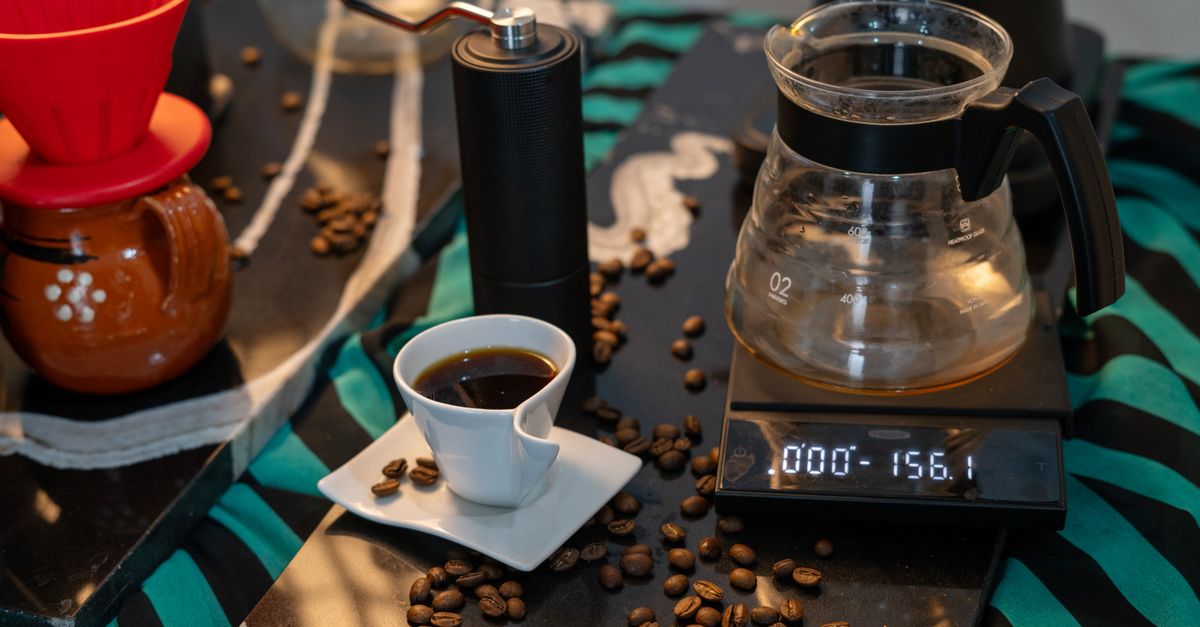
For pour over and filter, you need a platform large enough to take a carafe or a mug with a dripper on top without the whole assembly overbalancing. Stability matters more than compactness. A larger weighing surface with the display positioned so it is not obscured by the carafe is the practical requirement — several otherwise good scales put the display where a V60 sits directly over it.
If you do both, a mid-sized scale such as the Timemore or Brewista is the sensible compromise; a Lunar is arguably wasted on filter, and a large filter scale will not fit an espresso machine.
The Best Coffee Scales in Detail
Timemore Black Mirror Basic 2 — the value benchmark
The Timemore Black Mirror Basic 2 has become the default recommendation in home coffee circles, and it is the one to buy if you want most of the performance of a premium scale without the price.
According to Timemore it offers 0.1g resolution, a 2kg capacity, USB-C charging, and an auto-start timer that begins counting when it detects flow. The response time is the reason it is recommended so often — it is markedly faster and less smoothed than kitchen scales or cheaper coffee scales, which makes pouring to a target genuinely practical.
It is reasonably compact, so it fits many espresso drip trays, though not the tightest ones. Owner reviews are consistently positive on speed and build, with the most common criticisms being that it is not waterproof — spills are a real hazard — and that the rubberised coating on some versions marks easily. Expect around £55 to £75 at the time of writing.
Acaia Lunar — the espresso specialist
The Acaia Lunar is the scale you see on café bars, and it exists to solve the espresso problem specifically. According to Acaia it has a small footprint and low profile designed to fit under a group head, a water-resistant construction intended for life in a drip tray, and the fastest response in the range.
That combination is genuinely hard to find elsewhere, which is why it holds its price. The water resistance in particular addresses the way most coffee scales die. It offers several timing modes, including automatic espresso modes that start when the shot begins and stop when flow ceases, and it charges over USB-C.
The objection is straightforward: it costs several times what the Timemore does, and the difference in practical outcome for a home user is modest unless the size or water resistance specifically solves a problem for you. Owner reviews are strong on build and responsiveness, with occasional reports of battery degradation over years of use and a widespread view that it is expensive for what it is. Expect around £220 to £280 at the time of writing.
Acaia Pearl — the filter counterpart
The Acaia Pearl applies the same engineering to a larger platform intended for filter brewing. It shares the fast response and multiple timing modes, on a footprint sized for carafes and drippers rather than drip trays.
For pour over specifically, the appeal is the combination of a stable, generous weighing surface with a display that updates fast enough to pour accurately by. Acaia’s flow-rate display, which shows grams per second as you pour, is a genuinely useful training tool for anyone working on a consistent pour.
The Pearl is not designed for drip-tray use and is not as water resistant as the Lunar, so it is a filter scale rather than an all-rounder. As with the Lunar, the main criticism is price relative to alternatives that do most of the same things. Expect around £150 to £200 at the time of writing.
Brewista Smart Scale II — features for the money
The Brewista Smart Scale II occupies useful middle ground. According to Brewista it offers 0.1g resolution, a 2kg capacity, and six operating modes covering espresso and various filter workflows, including auto-tare and auto-timer options.
It also ships with a silicone heat-resistant pad, which is a small but practical touch given how often scales meet hot carafes. The mode variety is the main draw — different brew methods want different automatic behaviours, and having them built in reduces fiddling.
Owner reviews rate it well for the price while noting that the multiplicity of modes takes some learning, and that response, while good, is not quite at Timemore or Acaia level. Some report inconsistency in auto-start sensitivity. Expect around £60 to £85 at the time of writing.
Hario V60 Drip Scale — the simple filter option
Hario, the Japanese maker behind the V60 dripper, produces a scale designed to sit under its own equipment. The V60 Drip Scale offers 0.1g resolution and an integrated timer on a wide, flat platform.
Its virtue is simplicity and a design that assumes a V60 and carafe on top. It is well suited to someone brewing filter coffee who wants a scale that works without a manual, and it pairs naturally with the rest of the Hario range.
The limitations are that it runs on AAA batteries rather than USB rechargeable, the response is adequate rather than fast, and it is too large for espresso drip trays. Owner reviews are generally satisfied within those expectations, with occasional comments about the display being hard to read when a carafe sits over it. Expect around £45 to £60 at the time of writing.
How to Actually Use Them
Weighing coffee only helps if you use the numbers consistently. The two ratios worth knowing:
- Espresso brew ratio. Weigh the dry coffee going into the basket (the dose) and the liquid espresso coming out (the yield). A common starting point is a 1:2 ratio — 18g in, 36g out — over roughly 25 to 30 seconds. If the shot runs too fast, grind finer; too slow, grind coarser. Adjust one variable at a time.
- Filter brew ratio. Around 60g of coffee per litre of water is a widely used starting point, which scales to roughly 15g of coffee to 250g of water for a single mug. Weigh the water, do not measure it by volume in a jug, as it is far more accurate and no slower.
Two practical habits: tare the vessel first, then add coffee, then tare again before pouring water; and weigh your output, not your input, for espresso — what ends up in the cup is what you drink, and it varies with grind and puck behaviour even at a fixed dose.
FAQ
Do I really need 0.1g scales for coffee? For espresso, yes. The difference between an 18g and a 19g dose changes the drink noticeably, and 1g kitchen scales cannot resolve that reliably — they may display the same figure for both. For filter coffee at larger doses the argument is weaker, since a 0.5g error in a 30g dose matters far less proportionally, but 0.1g scales are cheap enough that there is little reason to compromise. Be wary of unbranded scales claiming 0.1g that actually round in coarser steps.
Why do coffee scales cost more than kitchen scales? Two reasons, one legitimate and one less so. The legitimate one is response time: coffee scales update several times a second with minimal smoothing so you can pour accurately to a target, where kitchen scales lag and average the reading to look stable. Water resistance, integrated brewing timers and compact drip-tray footprints add further cost. The less legitimate reason is branding — premium scales command prices well beyond their component cost, and mid-range options such as Timemore deliver most of the practical benefit.
Will a coffee scale fit under my espresso machine? Check before buying, as this defeats a lot of purchases. Measure the vertical clearance from the drip tray to the bottom of the portafilter spouts, and the flat area available in the tray. Many domestic machines leave very little room, which is why low-profile scales such as the Acaia Lunar exist. If clearance is tight, some people weigh the cup before and after instead, or place the scale beside the machine and simply weigh the finished shot.
Are Bluetooth and app features worth paying for? For most home brewers, no. App connectivity typically offers shot logging and graphing, which is genuinely interesting for a week or two and then goes unused by the majority of owners. The features that make a daily difference are resolution, response speed, a reliable auto-start timer, and physical durability. If you are the kind of person who will actually analyse logged brew data, it is worth having; otherwise spend the money on a better grinder.