Best Coffee Filter Papers UK (2026): Hario V60 White, Natural Brown & Fast-Flow Alternatives
Pick great beans, grind them well and heat your water to the right temperature — then watch the entire brew get funnelled through a single sheet of paper.
Best Coffee Filter Papers UK (2026): Hario V60 White, Natural Brown & Fast-Flow Alternatives
Pick great beans, grind them well and heat your water to the right temperature — then watch the entire brew get funnelled through a single sheet of paper. In pour-over coffee, the filter is the last thing your coffee touches before the cup, so it shapes flavour, flow rate, body and even brew temperature. It is not a passive extra; it is effectively an ingredient.
This guide compares the filter papers that UK home brewers actually buy in 2026, whether they are running a Hario V60, a flat-bottom dripper or an AeroPress. We researched manufacturer specifications and current UK pricing, and analysed owner feedback across speciality-coffee communities, to build a proper shortlist. One honest caveat before we start: retail prices in this category shift constantly between sellers and seasons, so every figure below is an approximate guide rather than a fixed price list.
If you only want the short answer, here it is.
Quick Picks — The Best Coffee Filter Papers in the UK
| Product | Best For | Approximate Price |
|---|---|---|
| Hario V60 White (Size 02, 100-pack) | Overall benchmark | Around £8 |
| Hario V60 Natural Brown (Size 02, 100-pack) | Eco-conscious brewing | Around £9 boxed |
| Cafec Abaca (Size 02, 100-pack) | Fast drawdown / stalling brews | Around £12–£14 |
| Kalita Wave 185 (100-pack) | Flat-bottom brewers | Around £10–£12 |
| AeroPress Paper Filters (350-pack) | AeroPress brewing | Around £8–£10 |
How to Choose Coffee Filter Papers
White vs natural brown — what you are actually tasting
The most important fork in the road is bleaching. White V60 papers are oxygen-bleached to strip out the natural wood colour and much of the flavour compounds that would otherwise rinse into your coffee. Hario officially confirms that it uses oxygen (ECF/TCF) bleaching — not elemental chlorine — on product packaging and UK distributor materials, which matters if you care about how your paper was manufactured. Because oxygen bleaching neutralises the papery taste, white filters are the default choice for brewers who want the bean, and only the bean, in the cup.
Natural brown papers, by contrast, skip the bleaching stage entirely. They are the more obvious environmental choice and carry a pleasingly unprocessed story, but they come with a trade-off: many drinkers notice a faint cardboard-like note that persists without rinsing. Both Hario and Cafec recommend a 100 ml hot-water pre-rinse in their official brew guides to eliminate this. Once rinsed, unbleached paper behaves beautifully — often with a marginally fuller mouthfeel than its white equivalent.
The environmental trade-off is more nuanced than it first appears. The lifecycle debate is live in speciality coffee circles because unbleached paper requires heavier fibre mass (higher gsm) to achieve equivalent wet-strength, partially offsetting the bleaching saving. No published peer-reviewed lifecycle assessment specific to coffee filters exists as of 2026, so any definitive environmental claim one way or the other should be treated with caution.
Thickness, flow and mouthfeel
Paper thickness — measured in grammage, or grams per square metre (gsm) — dictates how quickly water drains through the coffee bed. Thin, open-pored paper drains fast, producing a lighter, cleaner, more tea-like cup with less sediment. Thicker paper holds water on the grounds for longer, extending contact time and adding body and a touch of sweetness, but it also raises the risk of stalling a fine grind.
V60 papers sit at the quick end of the brewing spectrum by design, which is why the dripper is so forgiving. The main exception worth knowing about is Cafec’s Abaca line, whose heat-treated fibre structure is engineered to flow faster still. If your brews run long and bitter, switching to a faster paper is often a cheaper fix than buying a new grinder.
Cone vs flat-bottom vs disc
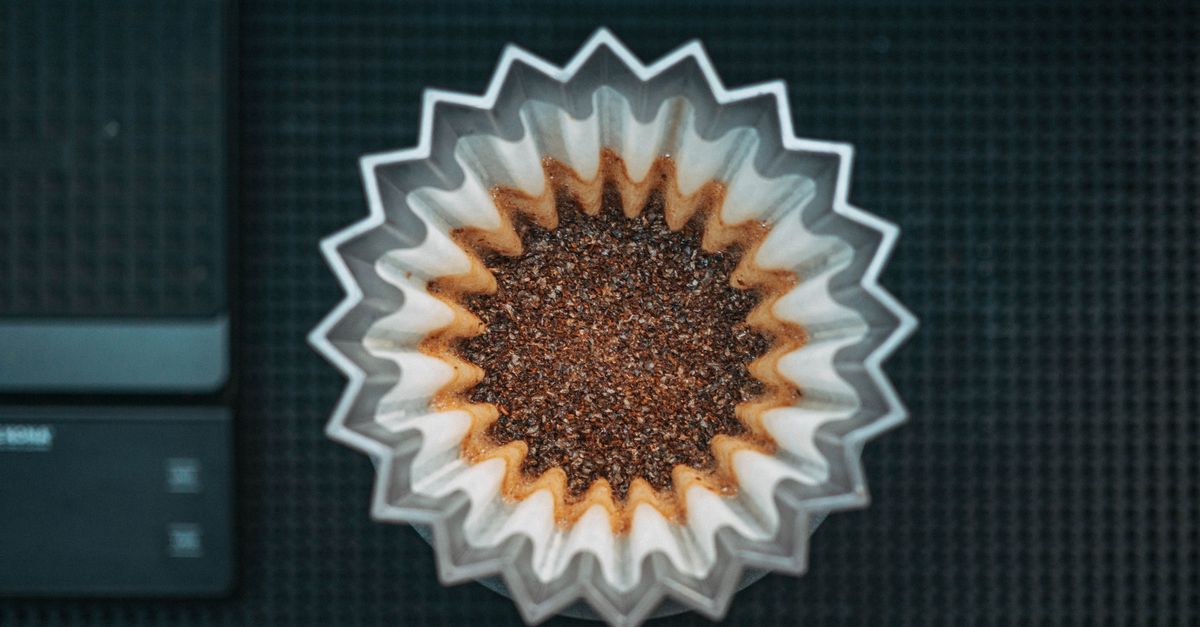
Your dripper’s geometry dictates the filter shape. Conical V60 filters sit in a 60° cone and channel water toward a single point at the tip — this concentrates flow and demands precise grind and pour technique. Flat-bottom filters, such as the Kalita Wave, spread the coffee bed across a wider, shallower area with a flat base and ridged walls that minimise contact between paper and dripper, reducing heat loss and encouraging a more even extraction. Disc filters, used in the AeroPress, are a different category entirely: they are thin, flat circles designed for immersion rather than percolation brewing.
Hario V60 White 02 (100-Pack)
Best for: The overall benchmark — neutral-tasting, precisely fitting, and the paper most UK pour-over brewers should start with.
Key specs: Approximately 25–30 gsm (community-cited; Hario does not publish official grammage). Size 02, 100 sheets per pack. Oxygen (ECF/TCF) bleached, confirmed by Hario on product packaging and UK distributor materials.
What’s included: 100 flat-bottomed conical filter papers, size 02, designed to fit the Hario V60 02 dripper.
Standout strength: These are the neutral-tasting, precisely fitting benchmark against which all other pour-over papers are measured. The oxygen bleaching process strips out papery flavour compounds, so there is minimal risk of contaminating the cup with unwanted notes. At approximately £8 per 100-pack, they represent the best value-to-performance ratio in the category.
Caveat: Hario does not publish an official grammage figure, so the 25–30 gsm range cited across communities is an approximation rather than a manufacturer specification. If you need guaranteed consistency for competition-level brewing, the lack of a published spec may give pause.
Verdict: The default choice for V60 brewers — affordable, neutral, and stocked everywhere that matters.
Where to buy: Widely stocked at Hasbean, Pact, Amazon UK, and Waitrose (selected stores).
Hario V60 Natural Brown 02 (100-Pack)
Best for: Eco-conscious brewers who prefer unbleached paper and are willing to rinse thoroughly.
Key specs: Size 02, 100 sheets per pack, boxed. Unbleached (no oxygen or chlorine bleaching stage). Heavier fibre mass than the white equivalent to achieve equivalent wet-strength, as covered above.
What’s included: 100 unbleached conical filter papers, size 02, in a retail box.
Standout strength: Skipping the bleaching stage entirely means no chlorine compounds and no oxygen-processing chemicals enter the manufacturing chain. Many brewers also report a marginally fuller mouthfeel from natural brown paper, which can complement medium and dark roasts where a touch more body is welcome.
Caveat: The papery taste persists without rinsing — this is not a subtle effect. Hario’s own brew guides recommend a 100 ml hot-water pre-rinse, and that recommendation exists specifically because unbleached paper carries more flavour compounds than its oxygen-bleached counterpart. Skip the rinse and you will taste it.
Verdict: A solid unbleached option at approximately £9 boxed — slightly pricier than white but a fair trade-off if avoiding bleached paper matters to you.
Where to buy: Widely stocked at Hasbean, Pact, Amazon UK, and Waitrose (selected stores).
Hario V60 Size 01 and Size 03
Best for: Brewers running the smaller V60 Mini or Switch (size 01), or those seeking the larger size 03 for batch brewing.
Key specs: Size 01 fits the Hario V60 01 dripper, including the Hario Mini and the Hario Switch. Size 03 fits the Hario V60 03 dripper. Available in both white and natural brown.
What’s included: 100 conical filter papers in the chosen size and bleaching type.
Standout strength: The size 01 is the natural partner for the Hario Switch — the immersion-plus-drip device that has grown in popularity among UK enthusiasts — and the Hario Mini travel dripper. It accommodates a maximum of roughly 20 g of coffee, which is ideal for single-cup brewing. The size 02, by contrast, handles up to approximately 30 g, enough for a large single cup or a modest two-cup brew. The geometry of each size differs, so they are not interchangeable: a size 01 filter will collapse or sit incorrectly in a size 02 dripper, and a size 02 filter will fold awkwardly in a size 01.
Caveat: The size 03 is rarely stocked outside specialist online retailers in the UK, so if you need it, expect to order from a dedicated coffee equipment store rather than a general marketplace.
Verdict: Essential to match the filter size to your specific dripper — check whether you own a 01, 02 or 03 before ordering.
Where to buy: Same retailers as the size 02 — Hasbean, Pact, Amazon UK, Waitrose (selected stores) — though size 03 availability is limited to specialist online retailers.
Hario x Project Waterfall
Best for: Brewers who want their filter paper purchase to contribute to a charitable cause.
Key specs: Size 02, 100 sheets per pack. Confirmed charitable partner is charity: water.
What’s included: 100 conical filter papers, size 02, branded with the Project Waterfall collaboration livery.
Standout strength: Hario UK states that a percentage of sales funds clean-water projects in coffee-growing regions through the charity: water partnership. This means your filter paper purchase directly contributes to water access infrastructure in the communities that grow the coffee you brew. The collaboration is confirmed and active.
Caveat: The exact percentage of sales directed to charity: water is not publicly quantified on UK retail listings as of 2026. Hario UK acknowledges the partnership and the cause, but without a published figure, buyers cannot verify precisely how much of their purchase reaches the charitable projects.
Verdict: A meaningful way to give back through an everyday purchase — just be aware that the exact donation percentage is not disclosed.
Where to buy: Available through Hario UK’s retail partners, including Hasbean and selected online coffee retailers.
Cafec Abaca 02 (100-Pack)
Best for: Brewers experiencing stalling drawdowns or bitterness with standard papers — the grinder-upgrade alternative for flow problems.
Key specs: Manufacturer-stated grammage of approximately 28 gsm. Abaca fibre (manila hemp), heat-treated to produce a measurably wider pore structure. Size 02, 100 sheets per pack.
What’s included: 100 conical filter papers, size 02, manufactured from a heat-treated abaca-fibre blend.
Standout strength: This is the only paper in this guide with a manufacturer-engineered faster-flow claim backed by fibre-science documentation. The heat treatment applied to the abaca fibre widens the pore structure of the paper, and Reddit’s r/pourover regularly documents drawdown times roughly 20–30 seconds faster than standard Hario white papers. At approximately £12–£14 per 100-pack, the Abaca costs roughly 60–70% more per sheet than Hario white — but if your brews are stalling, running long, or tasting bitter because water cannot pass through the coffee bed quickly enough, this paper addresses the root cause directly rather than asking you to change your grind setting or buy a new grinder. It is the most technically interesting filter paper on the UK market.
Caveat: The price premium is the sharpest differentiator versus Hario. At roughly 60–70% more per sheet, the Abaca is an enthusiast purchase rather than an everyday value option. If your current brews are flowing well and tasting good, the faster drawdown may actually work against you by under-extracting the coffee.
Verdict: The premium fast-flow paper for brewers who need to fix stalling drawdowns without replacing their grinder.
Where to buy: Stocked at Hasbean, Coffeehit, and Amazon UK.
Cafec Light Roast Filter
Best for: Brewers working specifically with light-roast coffees who want a paper engineered for their roast profile.
Key specs: Separate SKU from the Abaca. Thinner paper with faster flow, deliberately engineered for lighter roasts.
What’s included: Conical filter papers in a dedicated light-roast formulation.
Standout strength: Light-roast coffees are denser and less soluble than darker roasts, which means they tend to resist water flow and can stall in thicker filters. Cafec’s Light Roast filter addresses this with a thinner paper construction that accelerates flow, preventing the extended contact times that can push a delicate light roast into over-extraction and astringency. It is a purpose-built tool rather than a generalist paper.
Caveat: This is a separate SKU from the Abaca — the two are distinct products, not variations of the same filter. The thinner paper that benefits light roasts may flow too quickly for medium and dark roasts, where you want more contact time to develop body and sweetness.
Verdict: A specialist paper worth seeking out if light roasts dominate your brewing rotation.
Where to buy: Available through Cafec’s UK retail partners, including Hasbean and Coffeehit.
Kalita Wave 185 Filters (100-Pack)
Best for: Flat-bottom dripper owners who want the deliberately slower, more even extraction that thick paper provides.
Key specs: Flat-bottom design, 185 size (the standard for most UK home brewers). Distinctly thicker than V60 papers. 100 sheets per pack.
What’s included: 100 flat-bottom wave filters, size 185, designed to fit the Kalita Wave 155 and 185 drippers (the 185 is the larger, more common size for UK home use).
Standout strength: The Kalita Wave filter’s flat-bottom geometry, combined with its deliberately thicker paper, slows flow and extends contact time between water and coffee grounds. This is an intentional design choice: where V60 papers prioritise speed, Kalita Wave filters prioritise even saturation and a more forgiving brew. The ridged wave structure also minimises contact between the filter and the dripper wall, reducing heat loss through the metal or ceramic body. For brewers who find V60 brews too fast or too variable, the Wave system offers a more repeatable experience.
Caveat: The thicker paper that slows flow is a double-edged sword if your grind is too fine — you risk stalling the brew entirely. The Wave system demands a coarser grind than a V60, and the filters are not interchangeable with any conical dripper.
Verdict: The definitive flat-bottom filter — buy these if you own a Kalita Wave, and appreciate the slower, more forgiving extraction they provide.
Where to buy: Available at Coffeehit and Amazon UK.
AeroPress Paper Filters (350-Pack)
Best for: AeroPress owners who want the clean, sediment-free cup that paper filtration provides.
Key specs: 350-micron diameter discs. AeroPress ships paper filters in packs of 350. Approximately £8–£10 per pack.
What’s included: 350 paper disc filters, each 350 microns in diameter, designed to fit the standard AeroPress and AeroPress Go.
Standout strength: Paper filtration removes the fine sediment and oils that metal filters allow through, producing a cleaner, brighter cup that many brewers prefer for lighter roasts. The 350-pack represents excellent value per filter — at approximately £8–£10 for 350 sheets, each individual filter costs a fraction of a penny. The AeroPress immersion brewing method means the filter does not control flow rate in the way a pour-over filter does; instead, it simply acts as a barrier between the brewed coffee and the cup, catching grounds and oils.
Caveat: Paper filters are single-use by design — they structurally degrade when wet and cannot be effectively reused. For brewers who want to eliminate ongoing filter costs, the Fellow Prismo reusable metal disc (approximately £25) and the Able Disk are the named metal reusable alternatives. These allow oils and some sediment through, producing a fuller-bodied cup, but they eliminate the need to repurchase paper.
Verdict: The standard, reliable choice for AeroPress brewing — 350 filters for around £8–£10 is outstanding value.
Where to buy: Widely available at Amazon UK and specialist coffee retailers.
UK Practical Notes
Sizing and compatibility
The most common mistake UK buyers make is ordering the wrong V60 size. The size 01 accommodates a maximum of roughly 20 g of coffee, while the size 02 handles up to approximately 30 g. The geometry differs between sizes, meaning they are not interchangeable — a size 01 filter will not sit correctly in a size 02 dripper, and vice versa. If you own a Hario Switch or Hario Mini, you need size 01. If you own the standard Hario V60 02 ceramic, plastic, glass or metal dripper, you need size 02.
Reusing filter papers
Reddit’s r/coffee consensus is firmly against reusing V60 papers on both taste and hygiene grounds. Paper filters structurally degrade when wet — the fibres break down, the pore structure distorts, and the filter loses its ability to trap fine sediment effectively. Flavours from previous brews also linger in the used paper, introducing stale notes into the next cup. The cost per filter is low enough (a fraction of a penny for AeroPress, roughly 8 pence for Hario V60 white) that reuse offers no meaningful saving.
Rinsing before brewing
Both Hario and Cafec recommend a 100 ml hot-water pre-rinse in their official brew guides. This serves two purposes: it eliminates papery taste (especially critical for unbleached natural brown papers, where the flavour is more pronounced) and it pre-warms the dripper and server. The rinse water should be discarded before adding coffee grounds.
Frequently Asked Questions
What is the difference between Hario V60 size 01 and size 02?
The size 01 accommodates a maximum of roughly 20 g of coffee, while the size 02 handles up to approximately 30 g. The geometry differs between the two sizes, so they are not interchangeable — you must match the filter to your specific dripper. The size 01 fits the Hario Mini and the Hario Switch, while the size 02 is the standard for most UK home brewers using the full-size V60.
Can you reuse V60 filter papers?
No. Paper filters structurally degrade when wet — the fibres break down and the pore structure distorts, compromising the filter’s ability to trap sediment. The r/coffee community consensus is firmly against reuse on both taste and hygiene grounds, as flavours from previous brews linger in the used paper. At roughly 8 pence per filter for Hario V60 white, the saving from reuse is negligible.
Do natural brown filter papers taste different?
Yes, the papery taste from unbleached natural brown paper persists without rinsing. Both Hario and Cafec recommend a 100 ml hot-water pre-rinse in their official brew guides to eliminate this flavour. Once rinsed, natural brown paper performs comparably to white, with many brewers reporting a marginally fuller mouthfeel.
Are white coffee filter papers bleached with chlorine?
No — Hario officially confirms that its white V60 papers use oxygen (ECF/TCF) bleaching, not elemental chlorine. This is stated on product packaging and UK distributor materials. Oxygen bleaching neutralises the papery taste that unbleached paper carries, producing a more neutral cup.
What makes Cafec Abaca filters different from standard Hario papers?
Cafec Abaca filters use a heat-treated abaca fibre (manila hemp) blend with a manufacturer-stated grammage of approximately 28 gsm. The heat treatment produces a measurably wider pore structure, and r/pourover regularly documents drawdown times roughly 20–30 seconds faster than standard Hario white. They cost roughly 60–70% more per sheet than Hario white, positioning them as a targeted solution for stalling brews rather than an everyday paper.
Are there reusable alternatives to AeroPress paper filters?
Yes. The Fellow Prismo reusable metal disc (approximately £25) and the Able Disk are the named metal reusable alternatives to the standard AeroPress paper filters. These allow coffee oils and some fine sediment to pass through, producing a fuller-bodied cup, and they eliminate the need to repurchase paper. The trade-off is a less clean, less bright cup compared to paper filtration.
Is there an environmental advantage to choosing unbleached filter papers?
The answer is genuinely nuanced. Unbleached paper avoids the bleaching process entirely, but it requires heavier fibre mass (higher gsm) to achieve equivalent wet-strength, which partially offsets the environmental saving from skipping bleach. No published peer-reviewed lifecycle assessment specific to coffee filters exists as of 2026, so the environmental debate remains unresolved in speciality coffee circles.